
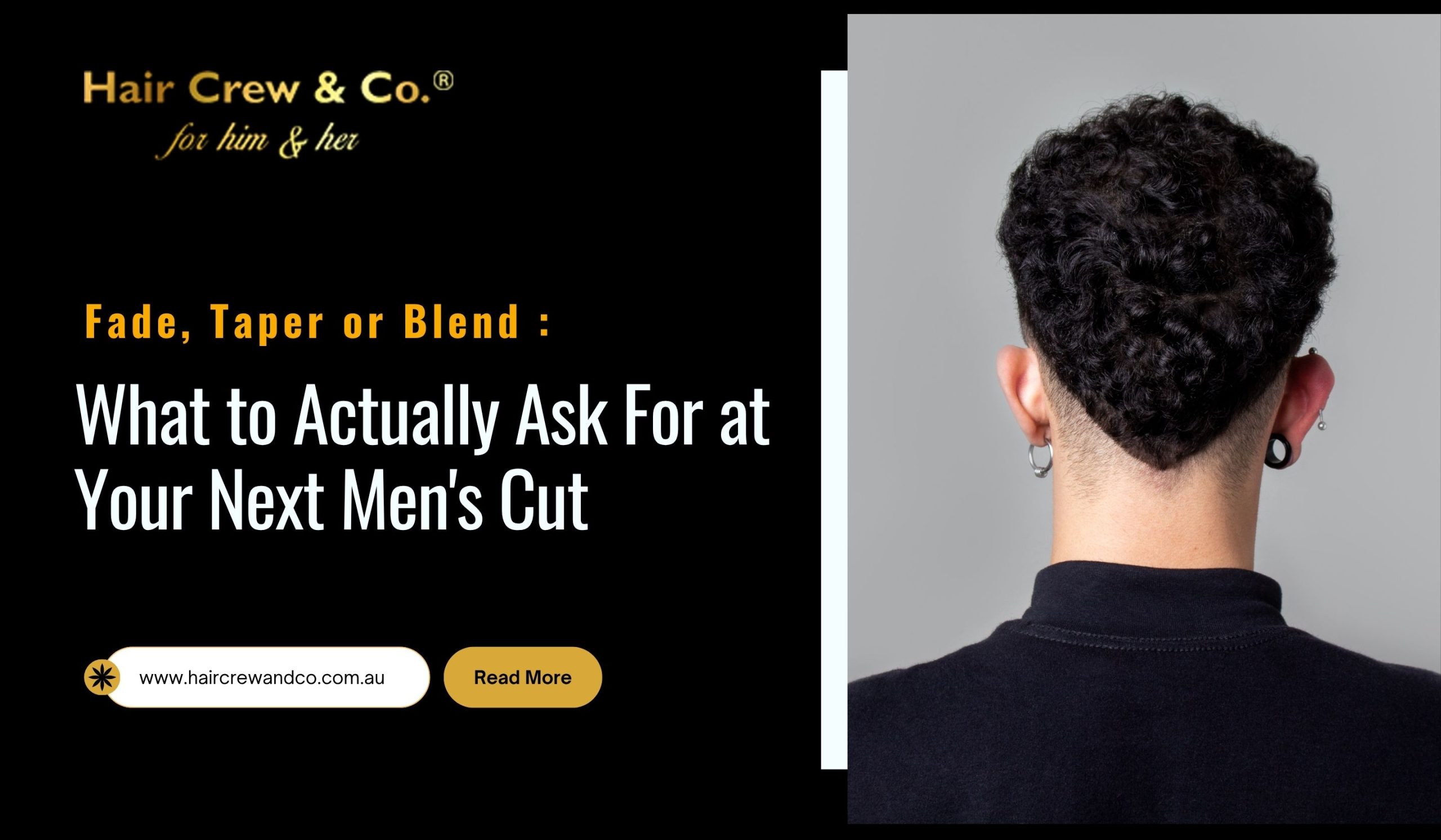
There is a moment in most men’s appointments where the whole thing quietly goes wrong. The stylist asks what you are after. You say short back and sides, tidy up the top, and you both nod as though an agreement has been reached. Twenty minutes later you are looking at a cut that is technically what you asked for and not at all what you pictured.
The problem is almost never skill. It is vocabulary. Three or four words do most of the heavy lifting in men’s cutting, and once you know what they actually mean, you can describe any cut you want in about fifteen seconds.
Taper, fade and blend are not synonyms
These get used interchangeably, including by people who should know better, and they describe different things.
A taper is the gradual shortening of the hair as it moves down towards the neckline and around the ears. Every good men’s cut has some form of taper. It is the classic, conservative version, and it usually leaves hair all the way down, just progressively shorter. A tapered neckline still has hair on it.
A fade is a taper taken much further, usually down to very short or all the way to bare skin at the bottom. Where a taper politely gets shorter, a fade disappears. The word describes the whole side of the head, not just the edge.
A blend is not a cut at all, it is the transition. It describes how smoothly one length melts into the next, with no visible step or line between them. When someone says a cut looks harsh or you can see the join, they are describing a poor blend. You can have a badly blended fade and a beautifully blended taper.
So a request like “a fade on the sides with a strong blend into the top” tells a stylist something real. “Short back and sides” does not.
Height is the other half of the instruction
Once you have chosen a fade, the next question is where it starts, and this changes the look far more than the length does.
A low fade begins just above the ear and follows the hairline around. It is subtle, works in almost any workplace, and grows out gently.
A mid fade starts around the temple, roughly level with the top of the ear. It is the middle ground and the safest choice if you are unsure.
A high fade begins up near the corner of the head where it starts curving towards the crown. It creates a strong contrast and a much bolder shape, and it grows out faster because there is more distance for the hair to travel.
Skin fade, bald fade, and zero fade all mean the same thing: the bottom of the fade goes to bare skin. That is a separate decision from how high it starts. You can have a low skin fade or a high one.
What clipper numbers actually mean
Clipper guards are numbered, and the numbers are simply lengths. A number one leaves roughly three millimetres, a number two around six, a number three around nine or ten, and a number four around twelve to thirteen. Each step up adds roughly three millimetres.
This is worth knowing because it lets you give feedback in a way a stylist can act on. Saying “the sides were a bit too short last time” is vague. Saying “we went a two last time, can we start at a three” is a precise instruction, and any stylist will be glad to receive it.
The top is a separate conversation
Most men spend all their words on the sides and none on the top, which is where the style actually lives. Decide what you want left on top in centimetres or by pointing at your fingers, whether you want it scissor cut or clippered, and how you intend to wear it. Pushed back, forward, textured and messy, or flat and neat all require different amounts of length and different internal cutting.
Say how you style it at home too, and be honest. If you own no product and never will, a cut that only works with three products is a bad cut for you regardless of how good it looks in the chair. Our cutting and styling team would rather build a shape that works with your actual routine than one that looks good for one afternoon.
Texture changes what is possible
This matters more than most guides admit. Straight, fine hair shows every line, so blends need to be gentler and skin fades expose the scalp quickly. Thick straight hair holds a sharp fade beautifully but can grow out looking blunt.
Curly and coily hair behaves differently again. It shrinks considerably when dry, so length that looks right when wet can end up far shorter than you expected. Fades on coily hair need to be cut with that shrinkage in mind, and the blend usually needs to travel further to look smooth. If you have texture and you are considering adding more shape or wave, our post on men’s perms covers how that works alongside a cut.
How often to come back
A high skin fade looks its best for about a week to ten days and noticeably grows out inside two to three weeks. A low taper with more length on top can go four to six weeks and still look intentional.
Choose the maintenance schedule you will realistically keep. There is no point in a razor sharp fade if you can only get in every six weeks, because you will spend most of that time in the grown-out phase. A tapered cut with more length on top ages far more gracefully and might suit your diary better.
Frequently Asked Questions
What is the difference between a fade and an undercut?
A fade is graduated, moving through several lengths from short at the bottom to longer at the top. An undercut is one single short length all the way up the side with a hard, deliberate line where it meets the longer hair on top. A fade blends; an undercut disconnects. If you like a strong contrast and a visible edge, you want an undercut, not a fade.
Can I get a fade if my hair is curly or coily?
Absolutely, and it often looks excellent. The things to discuss beforehand are shrinkage, since your hair will look considerably shorter dry than wet, and how far the blend needs to travel to look smooth. Ask your stylist to cut the top with your curl pattern in mind rather than cutting it flat and hoping.
What should I do if I do not know the name of the cut I want?
Bring photos, ideally two or three from different angles and on someone whose hair type looks similar to yours. Photos communicate far better than terminology. It also helps to say what you disliked about your last cut, since that rules things out quickly.
Should I wash my hair before I come in?
Clean and dry is ideal, but do not put product in it. Heavy wax or clay makes it harder to see how your hair naturally falls and sits, which is exactly what a stylist is reading when they decide where to place a blend.
Book Your Hair Appointment Today
Come in without the right words. That is our job, not yours.
If you would rather not memorise any of this, that is completely fine. Turn up, describe the last cut you actually liked, or show us a photo on your phone, and our stylists will translate it. We cut for men and boys at both salons, alongside beard trims, and you are welcome to book a straight cut or the full tidy-up.
Both salons are open seven days, and we look after clients from Blacktown, Parramatta and the surrounding western Sydney suburbs.
Parramatta
Shop 5078/159-175 Church St, Parramatta NSW 2150
02 9687 3313
Blacktown
Westpoint Shopping Centre, Shop 3070, Level 3/17 Patrick Street, Blacktown NSW 2148 (level 3)
02 9674 2076
info@haircrewandco.com.au | haircrewandco.com.au
Need a styling product that suits how you actually wear it? Ask at the counter or browse the range in our shop.

