
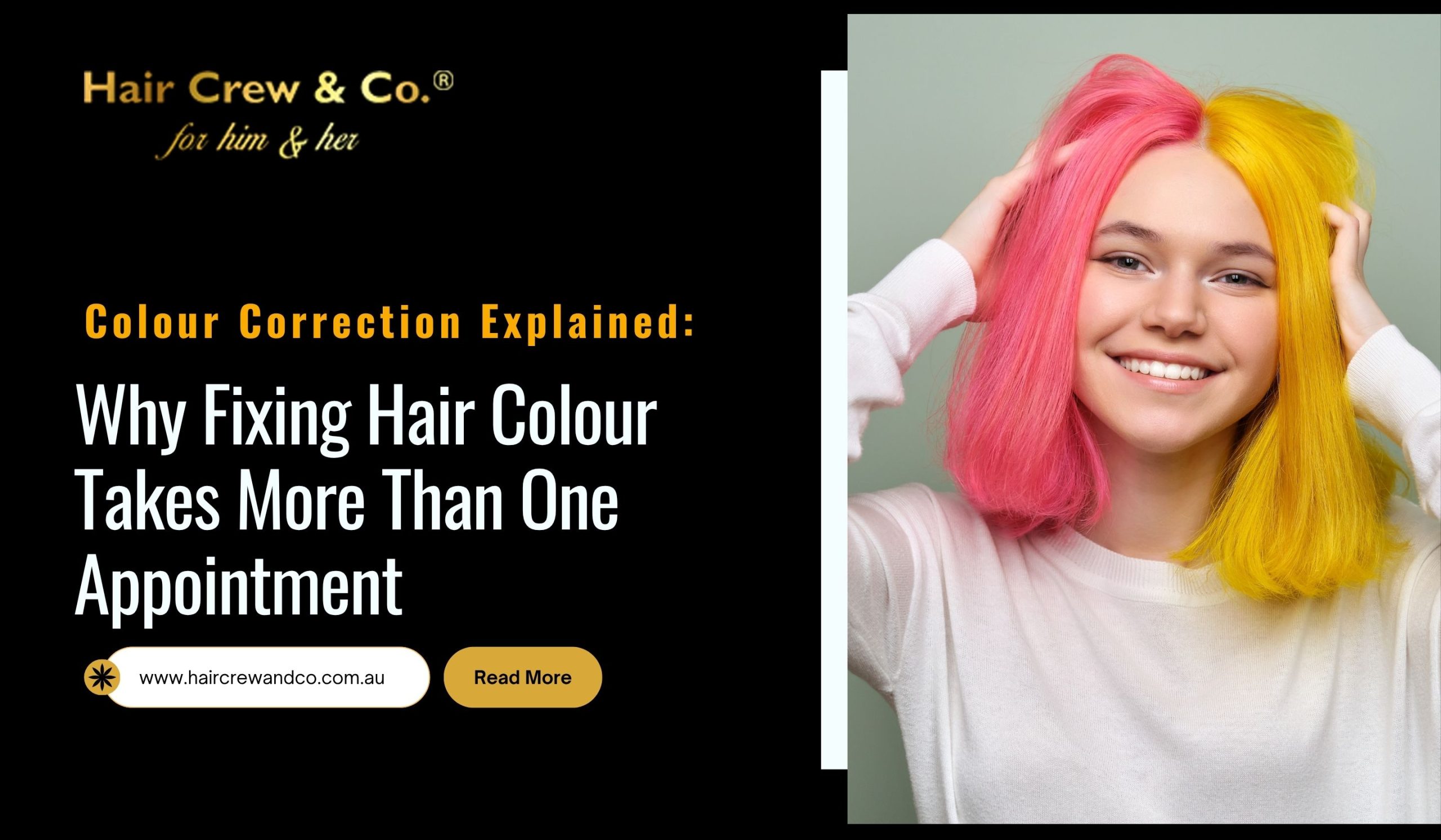
There is a particular kind of message salons receive on a Sunday night. It usually includes a photo taken in bathroom lighting, an apology, and a question about whether this can be fixed before Friday.
Almost always, yes. The part that surprises people is the timeline. Colour correction is not a longer version of a normal colour appointment. It is a different service with a different structure, and understanding why makes the whole process far less stressful.
What counts as a correction
A standard colour service takes your hair from where it is to where you want it. A correction has to undo something first.
That covers more situations than most people realise. Box dye that went considerably darker than the picture on the front. Bands of different tones through the lengths, where colour has been applied over colour for years. Brassy orange after an attempt at lightening. Patchy lift from a home bleach kit. Ends that have gone almost black from repeated build-up while the roots stay light. Tones that have drifted green or muddy.
The common thread is that there is existing artificial pigment in the hair behaving in ways nobody planned, and it has to be dealt with before anything new goes on.
Hair has a budget, and correction spends it
This is the single most useful thing to understand. Every chemical process uses up some of your hair’s structural integrity, and that reserve is finite. A stylist working on a correction is constantly weighing how much the hair can take against how far towards the goal they can get today.
That is why corrections happen in stages. Lifting years of accumulated dark colour out in one sitting is technically possible and frequently disastrous. Splitting the work across two or three appointments, spaced a few weeks apart with strengthening in between, gets you to the same place with hair still attached.
If a stylist tells you this will take more than one visit, they are not upselling you. They are declining to gamble with your hair.
Why they will not just bleach it out
People often ask this, and it is a fair question. The answer is that artificial pigment does not lift the way natural pigment does.
When you lighten dyed dark hair, the dye molecules break down unevenly and expose the underlying warmth in your natural hair, which runs through red, orange and yellow as it lifts. That is where brassiness comes from. It is not a mistake; it is a stage. Getting past it takes controlled lifting and then toning, and rushing straight to the end result is how hair snaps.
Different problems also need different tools. Build-up that has gone too dark may call for a colour remover rather than bleach. Banding usually needs different formulas applied to different zones in the same head, because the mid-lengths, ends and regrowth are all in different conditions. Unwanted tone can often be handled with a gloss and no lightening at all. Our colouring team works out which of these applies before deciding anything.
What happens at the consultation
Corrections nearly always start with a separate consultation rather than going straight into the chair, and the appointment is mostly questions.
Expect to be asked what has been on your hair and when, including anything from home, how many times, and whether any of it was applied over previous colour. Dates matter. A stylist will look at the hair in natural light, check the condition of the ends, and usually take a strand test on a hidden section to see how your hair actually responds before committing to a full head.
You will leave with a plan that has stages and realistic dates attached. Between those stages, strengthening and bond treatments do the work of getting your hair ready for the next round.
What you can do before you come in
The most helpful thing is to stop. Do not apply another box over the top, do not try a second home lightening kit, and do not use a colour stripper bought online. Each additional layer adds another variable, and corrections get harder and longer with every attempt.
Write down what you used, as precisely as you can manage. Brand, shade number, roughly when, and how many applications. If you still have the box, bring it. Guesswork costs time in the chair.
Send photos when you enquire, taken in daylight rather than bathroom light, showing roots, mid-lengths and ends. It lets the salon allocate the right amount of time, and colour corrections need far more of it than a standard booking allows.
Be prepared for the plan to shift
Two honest expectations are worth setting.
The first is length. Ends that have been through repeated colouring are often the weakest part of the hair, and cutting some off is frequently the fastest route to a good result. Many corrections involve losing more length than people hoped.
The second is the target. The shade you walked in wanting may not be achievable safely from where your hair currently is. A stylist may propose something close to it, or a staged route that arrives there over several months. That conversation is better had at the start than halfway through.
Once you are where you want to be, the maintenance matters. Keeping the result means sulphate-free products, controlled heat and regular toning, and our guide to extending the life of your colour covers the routine that protects the work.
Frequently Asked Questions
Can colour correction be done in one appointment?
Sometimes, if the problem is tonal rather than structural, a gloss to neutralise brassiness or even out a patchy tone can often be done in a single visit. Anything involving removing built-up dark colour or lifting significantly usually needs two or three sessions spaced a few weeks apart.
My hair went green after swimming. Is that a correction job?
Usually a small one. Green tones on blonde hair generally come from copper and minerals in pool water binding to porous hair, rather than from a colour error. It is often resolved with a clarifying treatment and a corrective gloss, which is much simpler than fixing a dye problem.
Will colour correction damage my hair?
Any chemical process has a cost, which is exactly why corrections are staged and paired with strengthening treatments. Done properly over several appointments, most people finish with hair in better condition than the damaged state they came in with, partly because the weakest ends usually get cut away along the journey.
Do I need a patch test before a correction appointment?
Yes, and book it well ahead. Patch tests need to be done a set period before colour is applied, and skipping that step is not something a reputable salon will do, even when you are in a hurry. Ask about it when you enquire so it does not delay your first session.
Discover a Style That Feels Like You
Send us a photo before you book anything.
Colour corrections cannot be squeezed into a standard appointment slot, and the worst outcome is arriving for an hour when your hair needs four. A daylight photo of your roots, lengths and ends, plus whatever you can tell us about what has already been on there, lets us book the right amount of time from the start.
We have seen every version of this, including the ones people are embarrassed about. There is no lecture waiting for you.
Both salons take correction work, with clients coming to us from Kings Park and right across the district.
Parramatta
Shop 5078/159-175 Church St, Parramatta NSW 2150
02 9687 3313
Blacktown
Westpoint Shopping Centre, Shop 3070, Level 3/17 Patrick Street, Blacktown NSW 2148 (level 3)
02 9674 2076
info@haircrewandco.com.au | haircrewandco.com.au
If you are working towards a wedding or an event, tell us the date when you first get in touch. Staged corrections need runway.

