
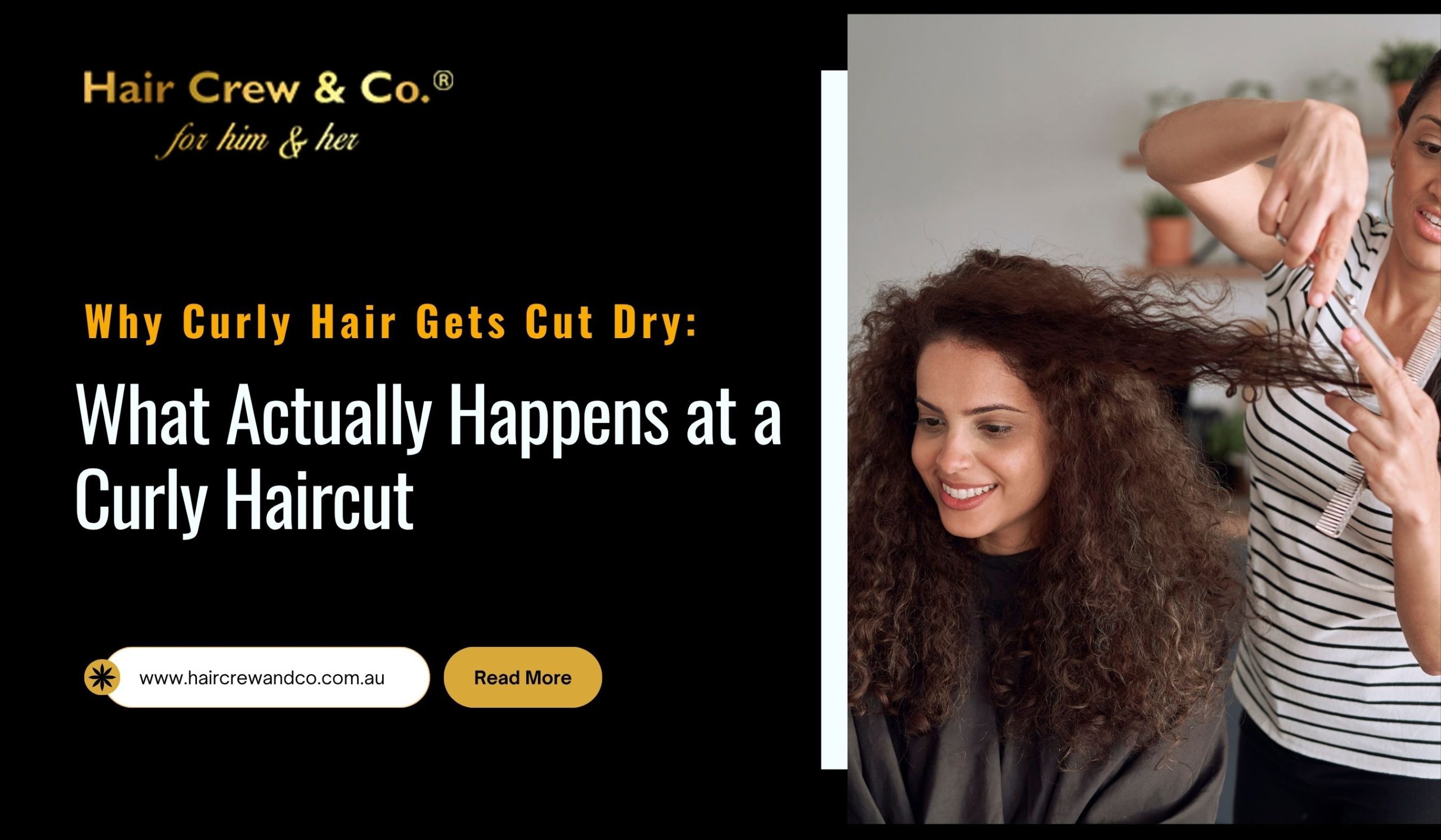
Most people with curls have a version of the same story. The cut looked lovely in the chair, all smoothed down and even. Then it dried, and it was several centimetres shorter than expected, wider at the bottom than the top, and sitting in a shape nobody agreed to.
That is not bad luck. It is what happens when curly hair is cut using the method designed for straight hair. Curls need a different approach, and the biggest difference is whether the hair is wet or dry when the scissors come out.
Wet hair lies to you
When you wet a curl and comb it straight, you stretch it to its full length and remove all the information a stylist needs. Every curl is now the same length, sitting in the same place, behaving the same way. None of that is true once it dries.
Curls do not fall in neat rows. One section might spiral tightly and sit high, while the section right beside it is looser and drops further. When hair is cut wet and combed under tension, all of that individuality is flattened out, then released the moment it dries. The result is uneven lengths that only appear after you have paid and gone home.
Shrinkage is the part people underestimate
Curly hair gets shorter as it dries, and the tighter the pattern, the more dramatic it is.
Loose waves might shrink very little. Defined ringlets can lose somewhere around a third of their stretched length. Tight coils can lose half or more, so hair that reaches the middle of your back when wet can sit at your shoulders when dry.
This is why the phrase “just take two centimetres off” is nearly meaningless on curly hair. Two centimetres removed from stretched hair can read as five or six once everything springs back up. Any length conversation about curls needs to happen in terms of where you want the hair to sit when dry, not how much is being cut off.
What a dry cut actually involves
At a dry cut, you arrive with your hair clean, dry and worn the way you normally wear it. The stylist works with the curls in their natural state, usually taking them curl by curl or in small natural groupings rather than in combed sections.
This means they can see exactly where each curl sits, which ones are longer than they appear, and where the overall shape is going wrong before anything is removed. They can also see damage and split ends that are invisible when hair is stretched flat.
It is slower than a standard cut, and that is the point. What you are paying for is judgement about shape, not speed.
There are times a stylist will still wet the hair, and that is not a red flag. Big changes in length, structural work through the interior, or looser wave patterns are sometimes better handled with a combination of both. Some of the best curly cutting is a hybrid, with the bulk shape set wet and the final refinement done dry.
The triangle problem
The most common complaint about curly cuts is the shape. Flat on top, wide at the bottom, generally described as a triangle or a pyramid.
This happens when length is removed from the ends without any weight being taken out of the sides and interior, so the hair stacks outward instead of falling. The fix is not simply adding layers everywhere, which on curls can create a different problem, with short pieces springing up and sitting above the rest like a halo.
What works is considered internal weight removal, placing layers according to where your curls actually sit, and giving the shape somewhere to go. This is genuinely skilled work, and it is why our cutting and styling team will spend time looking at your dry hair before deciding anything.
Your curl pattern changes the plan
Curls are not one category, and the differences matter at the cutting stage.
Loose waves tend to fall flat at the roots and need shape that encourages lift rather than removes it. Defined spiral curls usually need weight managed carefully, because too much removal makes them expand outward. Tight coils shrink the most, hold shape well, and often need length left specifically to account for that shrinkage.
Your hair may also do more than one of these at once. Many people have looser waves at the crown and tighter curls underneath, or a straighter section around the face. A stylist should be cutting to that reality rather than to a single curl type.
Coming in with straightened hair is the one thing to avoid
If you straighten your hair before a curly cut, the stylist cannot see any of the information they need. If you are booked for a curly cut, come with your curls out.
Wash a day or two before, wear it in its usual style, avoid heavy product buildup and do not tie it up on the way in. A ponytail flattens one side and leaves a dent that is difficult to work around. If you are between washes and your curls have gone flat, refresh them rather than pinning them back.
Between appointments, the routine matters as much as the cut. Our guide to caring for curly hair covers washing and styling, and if your curls have lost definition from heat or colour, a professional hydration treatment before the cut will show your stylist what your curl pattern really looks like when it is behaving.
Frequently Asked Questions
Should I wash my hair before a curly cut?
Wash it a day or two ahead rather than that morning. You want clean hair without product buildup, but curls often sit better on day two than on wash day. Arrive with it fully dry and worn normally, because damp hair has not finished shrinking and the shape is still settling.
How much shorter will my curls look once they dry?
It depends on your pattern. Looser waves change very little, spiral curls commonly lose around a third of their stretched length, and tight coils can lose half or more. Ask your stylist to show you where the length will sit dry before cutting, rather than agreeing to a measurement.
Is dry cutting only for tight curls, or do waves benefit too?
Waves benefit as well, particularly for the finishing work. Looser patterns often get their overall shape set wet and then refined dry, because waves reveal their fall as they dry just like tighter curls do, only less dramatically.
How often do curls need trimming?
Curly hair can generally go longer between cuts than straight hair, often somewhere in the range of three to four months, partly because the shape hides growth well. The limit is damage rather than length. Curls are drier at the ends by nature, and once a split starts travelling up the strand, it will not stop on its own.
Tell us your curl pattern when you book.
It sounds like a small thing, but it lets us allocate the right amount of time and pair you with a stylist who cuts curls regularly. A curly cut is not a standard appointment squeezed into the same slot, and rushing it is how the triangle happens.
If you have had a curly cut go wrong before, bring that with you too. Knowing what was taken out last time, and what you hated about the result, tells us more than a photo of someone else’s hair ever will.
We see curly and textured clients at both salons, and across Toongabbie and the surrounding suburbs.
Parramatta
Shop 5078/159-175 Church St, Parramatta NSW 2150
02 9687 3313
Blacktown
Westpoint Shopping Centre, Shop 3070, Level 3/17 Patrick Street, Blacktown NSW 2148 (Level 3)
02 9674 2076
info@haircrewandco.com.au | haircrewandco.com.au
Curls out, product light, nothing tied back. That is all the preparation we need from you.

